Performance metrics
- blur
- discriminator loss/accuracy ‘real’
- discriminator loss/accuracy ‘fake’
- generator loss/accuracy
- Number of parameters (trainable and Non-trainable)
Anything else?
GAN training process
- Train discriminator on 1/2 batch ‘real’ inputs.
- Train discriminator on 1/2 batch ‘fake’ inputs.
- Train GAN on 1 batch, but discriminator weights are marked ‘Non-trainable’. This results in the generator’s weights getting updated.
- Repeat
Testing Different (smaller) GAN architectures
In this model, number of filters for conv2d_transpose layers were changed from 128 to 100.
Model: "sequential_1"
_________________________________________________________________
Layer (type)                 Output Shape              Param #
=================================================================
dense_1 (Dense)              (None, 2500)              252500
_________________________________________________________________
leaky_re_lu_5 (LeakyReLU)    (None, 2500)              0
_________________________________________________________________
reshape (Reshape)            (None, 5, 5, 100)         0
_________________________________________________________________
conv2d_transpose (Conv2DTran (None, 10, 10, 100)       160100
_________________________________________________________________
leaky_re_lu_6 (LeakyReLU)    (None, 10, 10, 100)       0
_________________________________________________________________
conv2d_transpose_1 (Conv2DTr (None, 20, 20, 100)       160100
_________________________________________________________________
leaky_re_lu_7 (LeakyReLU)    (None, 20, 20, 100)       0
_________________________________________________________________
conv2d_transpose_2 (Conv2DTr (None, 40, 40, 100)       160100
_________________________________________________________________
leaky_re_lu_8 (LeakyReLU)    (None, 40, 40, 100)       0
_________________________________________________________________
conv2d_transpose_3 (Conv2DTr (None, 80, 80, 100)       160100
_________________________________________________________________
leaky_re_lu_9 (LeakyReLU)    (None, 80, 80, 100)       0
_________________________________________________________________
conv2d_5 (Conv2D)            (None, 80, 80, 3)         7503
=================================================================
Total params: 900,403
Trainable params: 900,403
Non-trainable params: 0
_________________________________________________________________- Model is 65% the size of the baseline model.
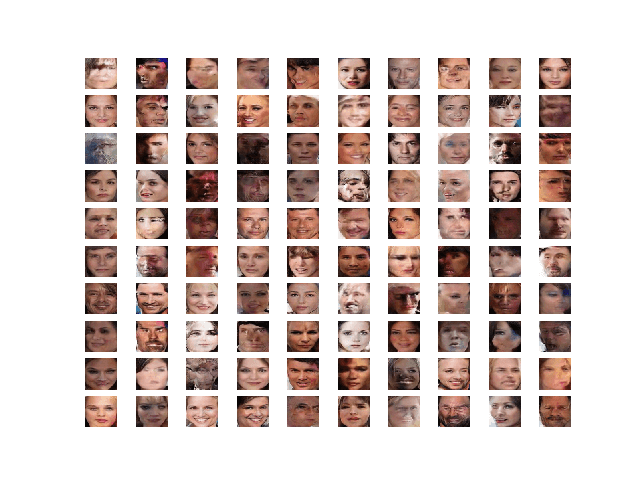
In this model, 2 conv2d_transpose layers were removed. Number of filters changed from 128 to 100.
Model: "sequential_1"
_________________________________________________________________
Layer (type)                 Output Shape              Param #
=================================================================
dense_1 (Dense)              (None, 2500)              252500
_________________________________________________________________
leaky_re_lu_5 (LeakyReLU)    (None, 2500)              0
_________________________________________________________________
reshape (Reshape)            (None, 5, 5, 100)         0
_________________________________________________________________
conv2d_transpose (Conv2DTran (None, 20, 20, 100)       160100
_________________________________________________________________
leaky_re_lu_6 (LeakyReLU)    (None, 20, 20, 100)       0
_________________________________________________________________
conv2d_transpose_1 (Conv2DTr (None, 80, 80, 100)       160100
_________________________________________________________________
leaky_re_lu_7 (LeakyReLU)    (None, 80, 80, 100)       0
_________________________________________________________________
conv2d_5 (Conv2D)            (None, 80, 80, 3)         7503
=================================================================
Total params: 580,203
Trainable params: 580,203
Non-trainable params: 0
_________________________________________________________________- Model is 42% the size of the baeline model.
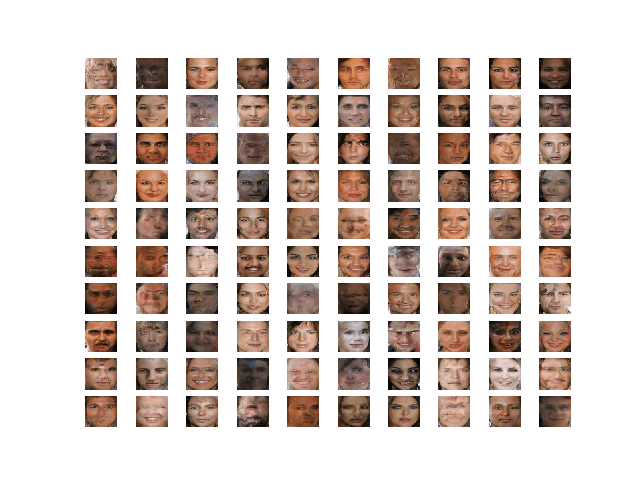
Training failure example?
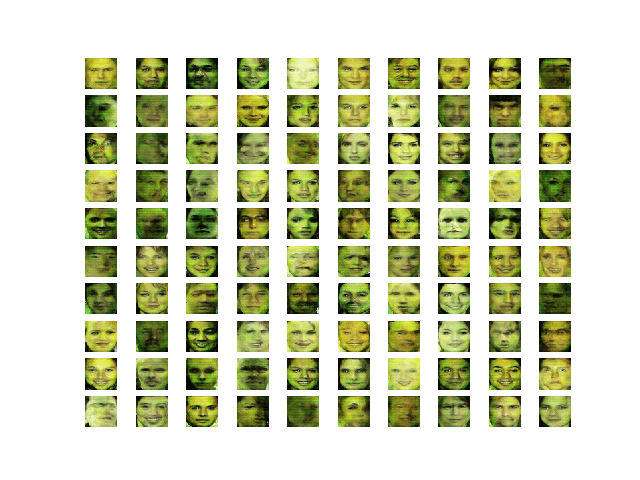
- Not really sure why everything turned green, but I thought it was interesting.
VAE-GAN
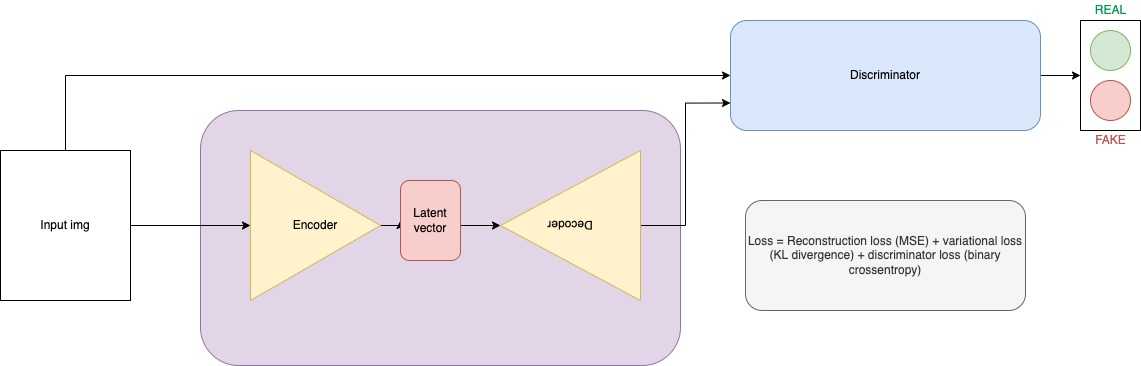
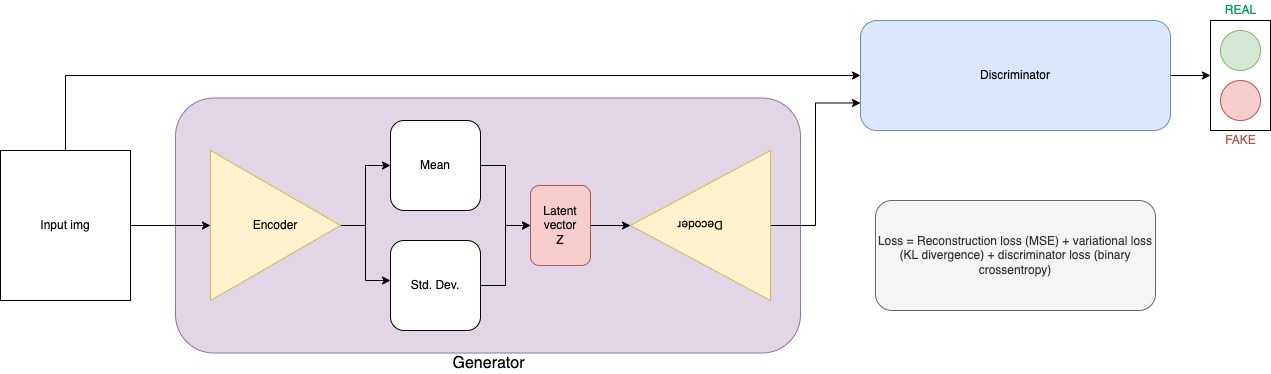 After attempting to use this architecture, I decided to go with an AE-GAN instead due to it being more simple
AE-GAN
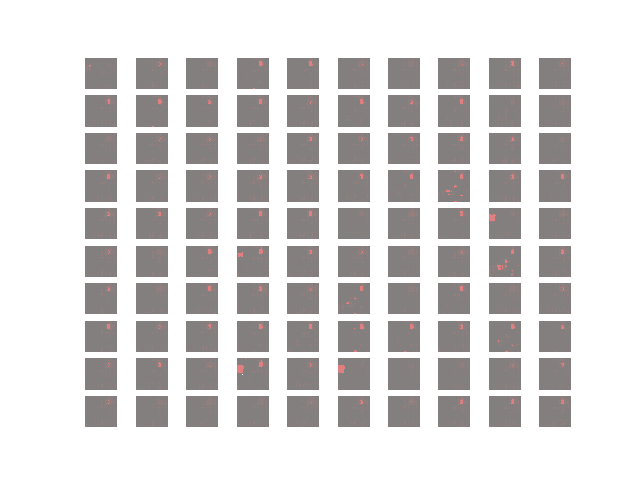
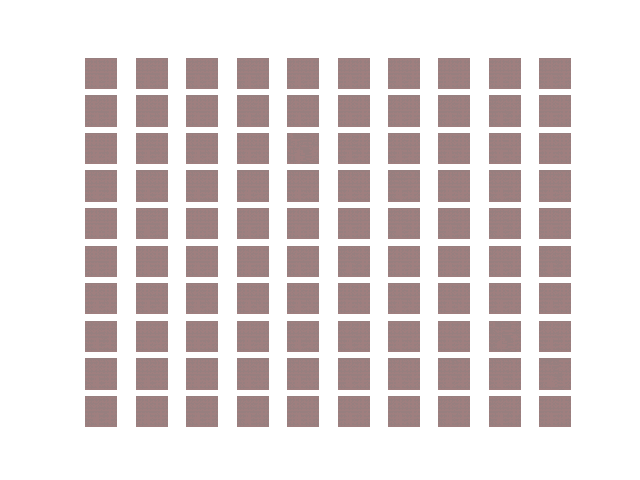
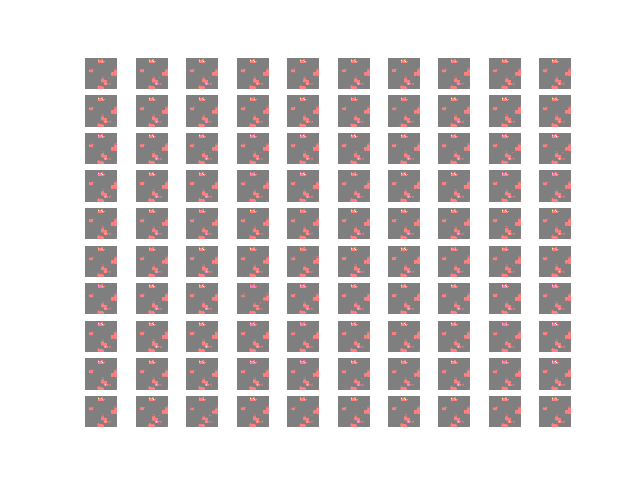
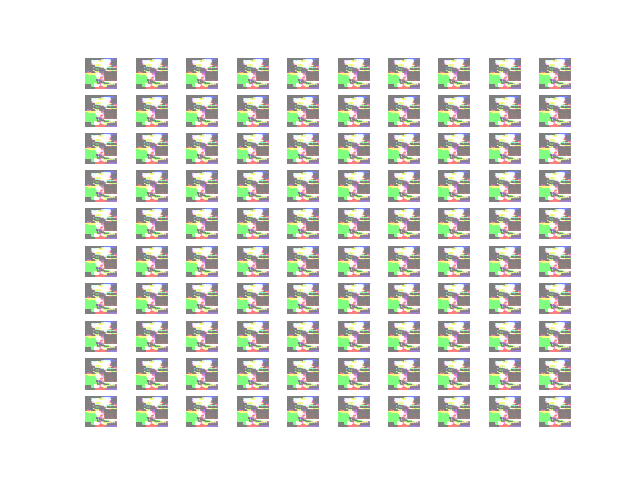
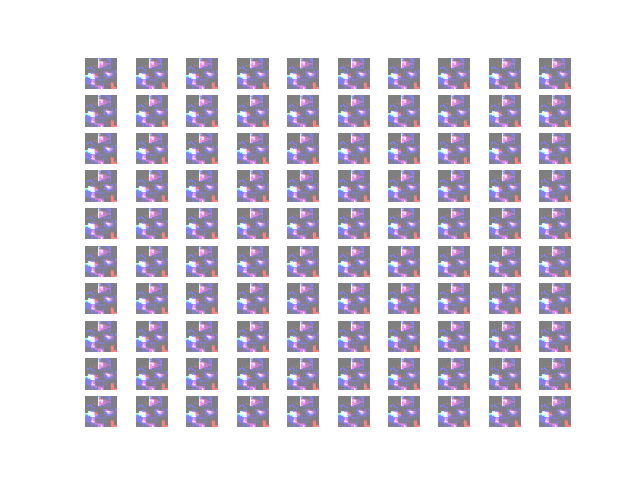
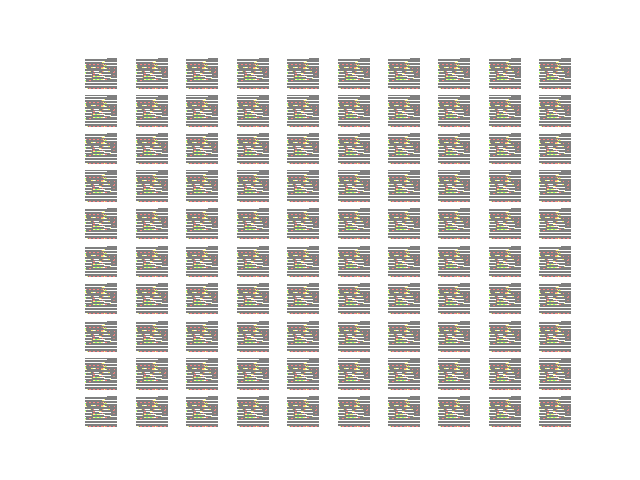
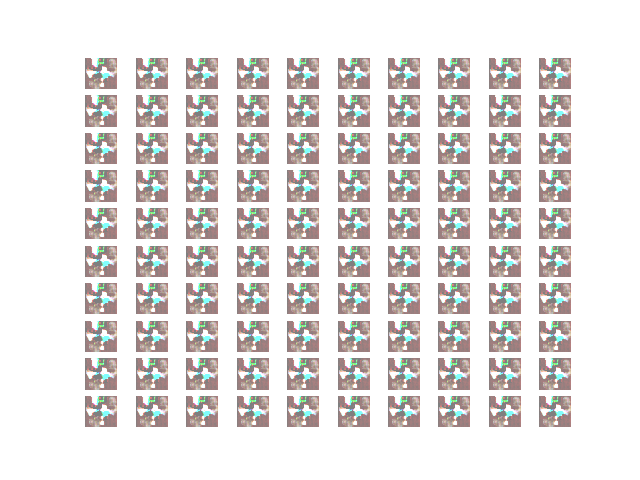
AE-GAN Convergence Failure?
Epoch 10
 Epoch 20
 Epoch 30
 Epoch 40
 Epoch 50
 Epoch 60
 Epoch 70
 Epoch 80
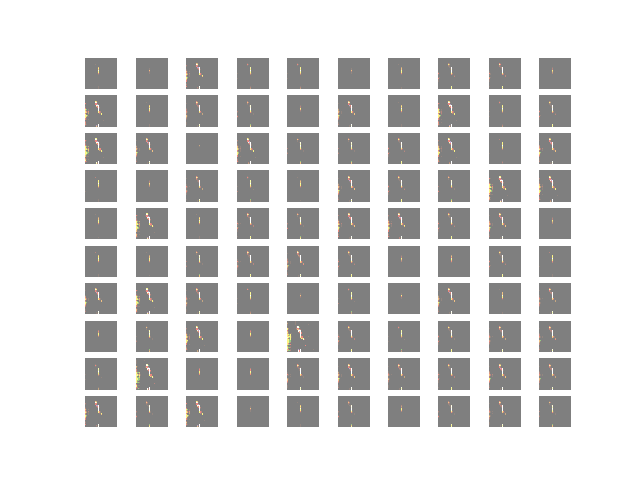 Epoch 90
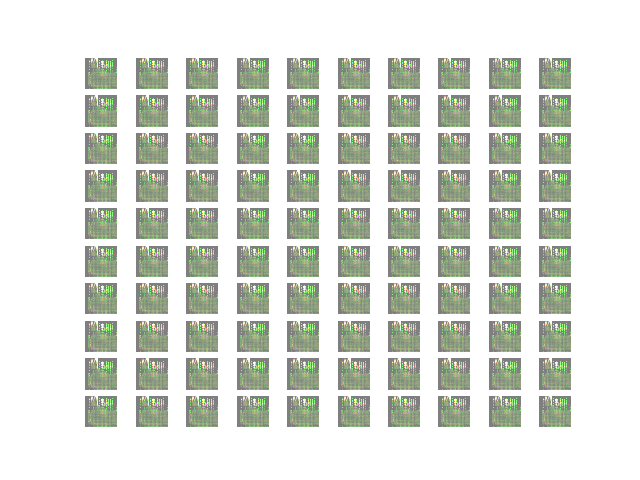 Epoch 100
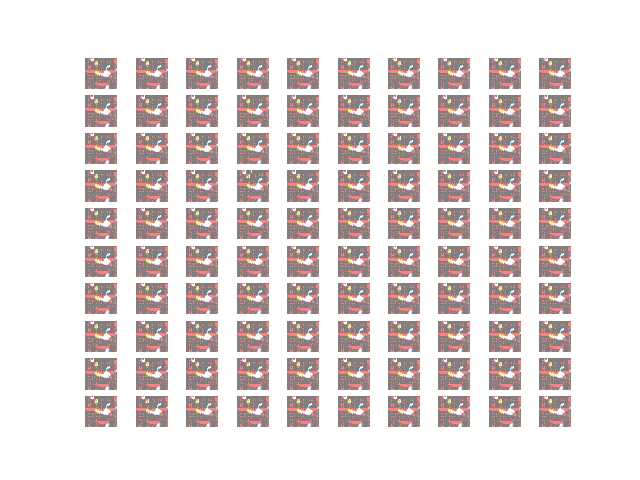
Typically, a neural network fails to converge when the model loss does not settle down during the training process. In the case of a GAN, a failure to converge refers to not finding an equilibrium between the discriminator and the generator.
- Loss of the discriminator has gone to 0, and stays there.
- Generator loss steadily rises over time.
This type of loss is most commonly caused by the generator outputting garbage images that the discriminator can easily identify.
Epoch, batch, discriminator loss 'real', discriminator loss 'fake', generator loss
>100, 350/390, d1=0.000, d2=0.000 g=3969.650
>100, 351/390, d1=0.000, d2=0.000 g=4073.821
>100, 352/390, d1=0.000, d2=0.000 g=3957.396
>100, 353/390, d1=0.000, d2=0.000 g=4028.773
>100, 354/390, d1=0.000, d2=0.000 g=4012.157
>100, 355/390, d1=0.000, d2=0.000 g=3974.358
>100, 356/390, d1=0.000, d2=0.000 g=4015.348
>100, 357/390, d1=0.000, d2=0.000 g=4000.741
>100, 358/390, d1=0.000, d2=0.000 g=3976.813
>100, 359/390, d1=0.000, d2=0.000 g=4044.082
>100, 360/390, d1=0.000, d2=0.000 g=4045.718
>100, 361/390, d1=0.000, d2=0.000 g=4030.518
>100, 362/390, d1=0.000, d2=0.000 g=3981.260
>100, 363/390, d1=0.000, d2=0.000 g=4023.841
>100, 364/390, d1=0.000, d2=0.000 g=4037.833
>100, 365/390, d1=0.000, d2=0.000 g=3964.532
>100, 366/390, d1=0.000, d2=0.000 g=4033.472
>100, 367/390, d1=0.000, d2=0.000 g=4026.272
>100, 368/390, d1=0.000, d2=0.000 g=4095.623
>100, 369/390, d1=0.000, d2=0.000 g=4043.215
>100, 370/390, d1=0.000, d2=0.000 g=3948.164
>100, 371/390, d1=0.000, d2=0.000 g=3994.030
>100, 372/390, d1=0.000, d2=0.000 g=4105.486
>100, 373/390, d1=0.000, d2=0.000 g=4081.369
>100, 374/390, d1=0.000, d2=0.000 g=4040.253
>100, 375/390, d1=0.000, d2=0.000 g=4031.456
>100, 376/390, d1=0.000, d2=0.000 g=4037.990
>100, 377/390, d1=0.000, d2=0.000 g=3988.677
>100, 378/390, d1=0.000, d2=0.000 g=4049.035
>100, 379/390, d1=0.000, d2=0.000 g=3993.023
>100, 380/390, d1=0.000, d2=0.000 g=4087.639
>100, 381/390, d1=0.000, d2=0.000 g=4030.921
>100, 382/390, d1=0.000, d2=0.000 g=4005.591
>100, 383/390, d1=0.000, d2=0.000 g=4033.066
>100, 384/390, d1=0.000, d2=0.000 g=3920.520
>100, 385/390, d1=0.000, d2=0.000 g=3939.916
>100, 386/390, d1=0.000, d2=0.000 g=4079.210
>100, 387/390, d1=0.000, d2=0.000 g=4078.109
>100, 388/390, d1=0.000, d2=0.000 g=4075.279
>100, 389/390, d1=0.000, d2=0.000 g=4007.191
>100, 390/390, d1=0.000, d2=0.000 g=4009.323
>Accuracy real: 100%, fake: 100%
New Proposed AE-GAN training process
- Train discriminator on 1/2 batch ‘real’ inputs.
- Train AE on 1/2 batch, input is real image, output is reconstructed image, loss is reconstruction loss.
- Train discriminator on 1/2 batch ‘fake’ (reconstructed) inputs.
- Train GAN on 1 batch, but discriminator weights are marked ‘Non-trainable’. This results in the generator’s weights getting updated.
- Repeat
- By adding the 1/2 batch training on the AE, I’m hoping it will reduce the chance of convergence failure due to some prior training at reconstruction. It might be able to fool the discriminator a little better.
I tried doing this, however, I’m having trouble because the generator model needs to not be compiled for step 5, but must be compiled for step 2. I think this is an area where my tensorflow knowledge is limiting and I could use some help figuring out how to do that.
Conclusion
-
If we want to continue to pursue this AE-GAN idea, we need to simplify the problem.
- MNIST: Single digit?
-
Got good results on GAN size reductions. No convergence failure observed.
- Could continue to reduce the size until convergence failure.
Currently working on
- Test script to get metrics on each model. See Performance metrics section
- Getting new AE-GAN training process to work.
- Training a new AE-GAN model with an AE that more closely resembles the baseline generator.
- Changing the baseline GAN model to have a generator with a latent space.